
By Fire Alarm Blueprint Trainer Editorial Team · Reviewed by Fire Alarm Blueprint Trainer Review Board — reviewed against NFPA 72 & NFPA 70 principles
Smoke vs Heat Detectors: How to Choose
The right detector in the right place detects real fires faster and avoids false alarms. Here's how smoke and heat detection compare.
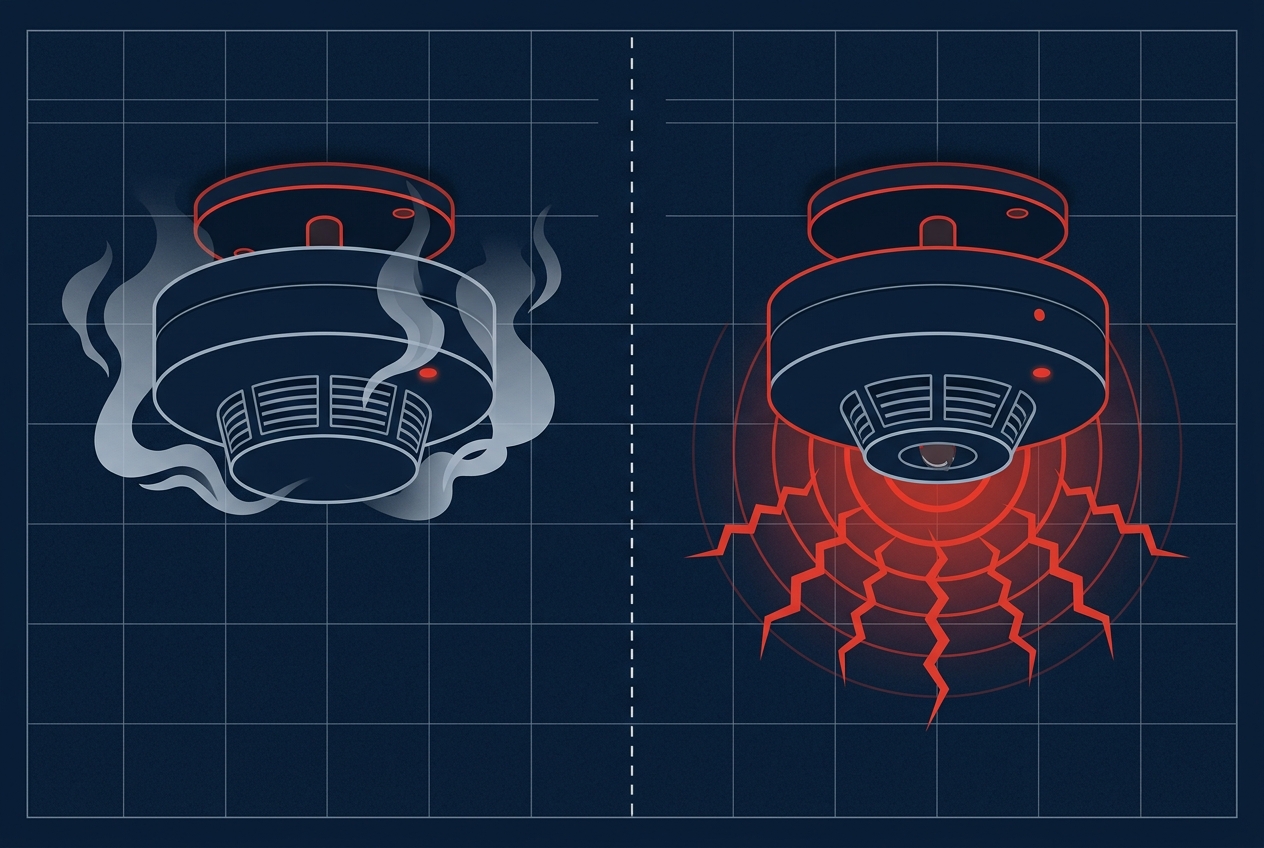
Smoke detection types
Photoelectric sensors respond well to larger particles from smoldering fires; ionization sensors respond to smaller particles from fast, flaming fires. Multi-criteria detectors combine methods to improve response and reject nuisances.
Heat detection types
Fixed-temperature detectors activate at a set threshold; rate-of-rise detectors respond to a rapid temperature increase. Heat detection suits dusty, dirty, or high-heat areas where smoke detection would cause nuisance alarms.
Matching detection to the space
Consider ceiling height, airflow, ambient dust and humidity, and the expected fire type. Keep detectors away from supply diffusers and dead-air pockets, and follow the manufacturer's spacing and listing.
Spacing rules under NFPA 72
Spot-type smoke detectors have a listed spacing (often referenced around a 30-foot nominal spacing on smooth, flat ceilings) that must be reduced for high ceilings, beams, joists, sloped ceilings, and airflow. Heat detectors are spaced by their listing and temperature rating. Spacing is a starting point, not a guarantee — NFPA 72 requires adjustments for ceiling construction and airflow, and detectors must be kept away from supply diffusers that can dilute smoke before it reaches the sensor. Always verify the listed spacing and the adopted edition's adjustment rules with the AHJ.
This article is educational and non-authoritative. It is not a substitute for the adopted code edition, manufacturer instructions, licensed design, or AHJ approval.
Frequently asked questions
What's the difference between photoelectric and ionization smoke detectors?
Photoelectric sensors respond well to larger particles from smoldering fires, while ionization sensors respond to smaller particles from fast, flaming fires. Multi-criteria detectors combine methods to improve response and reject nuisance alarms.
When should I use a heat detector instead of a smoke detector?
Use heat detection in dusty, dirty, or high-heat areas where smoke detection would cause nuisance alarms. Fixed-temperature detectors trip at a set threshold; rate-of-rise detectors respond to a rapid temperature increase.
How do I reduce nuisance alarms?
Match the detector technology to the environment, keep detectors away from supply-air diffusers and dead-air pockets, and follow the manufacturer's spacing and listing.