
Learning Center

Fire Alarm Training Curriculum

A guided NFPA 72 learning path from fundamentals to advanced systems, in original plain language. These are learning aids only — always verify exact requirements in the officially adopted standards and with your AHJ.

NFPA 72 Learning Path

0/9 core modules passed

Ask a Fire-Code Question

Plain-language answers to NFPA 72/70 questions, grounded in cited web sources. Educational guidance only — not code or design authority.

NFPA 72 Overview

1

What NFPA 72 is

NFPA 72, the National Fire Alarm and Signaling Code, is the widely adopted framework for the design, installation, testing, and maintenance of fire alarm and signaling systems. Jurisdictions adopt specific editions, sometimes with local amendments.

Download NFPA 72 (2025) PDF
Why it matters

NFPA 72 is the common language of the industry. Knowing how it's organized helps you find relevant concepts — but the adopted edition and AHJ always govern the actual requirements.

2

What you'll learn

Video lesson

NFPA 72 Basics for Entry-Level Fire Alarm Technicians

A 7-minute walkthrough of what NFPA 72 covers across a system's life — from the adopted edition and the AHJ's role, to initiating devices, notification appliances, IDC/SLC/NAC circuits, the three signal types, and why ITM documentation matters.

Watch on YouTube
Learning objectives
  • Explain what NFPA 72 covers and how it relates to NFPA 70 (NEC) and NFPA 101 (Life Safety Code).
  • Describe the practical difference between a 'standard' and a 'code', and why the adopted edition and local amendments determine what applies.
  • Identify the stakeholders who rely on NFPA 72 — designers, installers, inspectors, owners, and occupants.
Prerequisites
3

How the code works

What NFPA 72 covers

The code addresses the application, installation, performance, testing, and maintenance of fire alarm systems, signaling, and emergency communications. It is a framework of requirements and performance goals, not a product catalog.

Editions and adoption

NFPA publishes editions on a cycle. A jurisdiction adopts a particular edition — which may not be the newest — and can add local amendments. The adopted edition, not the latest one, is what applies to a given project.

How to use it responsibly

This trainer never reproduces copyrighted code text. Use NFPA 72 concepts to guide thinking, then verify exact requirements in the officially adopted standard and confirm interpretations with your AHJ.

Interactive walkthrough

Step 1 of 3

What NFPA 72 covers

The code addresses the application, installation, performance, testing, and maintenance of fire alarm systems, signaling, and emergency communications. It is a framework of requirements and performance goals, not a product catalog.

4

Vocabulary & common mistakes

Key terms
NFPA 72
The National Fire Alarm and Signaling Code.
Adopted edition
The specific code edition a jurisdiction has put into law, which governs a project.
Local amendment
A jurisdiction-specific change to the adopted code.
Common pitfalls / potential review items
  • • Assuming the newest edition applies instead of the adopted one.
  • • Overlooking local amendments.
  • • Treating memorized rules as universal without verifying the adopted text.
5

Practice

Guided practice

Section references (e.g. 'per NFPA 72 Chapter 12') are useful because they let you:

Independent challenge

The authority who interprets and enforces the code locally is the:

We never embed copyrighted code text — add your own authorized references.

6

Code sections every tech should know

References use NFPA 72 2019/2022 numbering — section numbers can shift between editions, so confirm in the edition your AHJ has adopted.

Code section 1

"Shall" is a requirement, "should" is advice

"Shall" is a requirement, "should" is advice

NFPA 72 uses two very different words. "Shall" means mandatory — you must do it to comply. "Should" means recommended, and it only appears in the annexes. Annex A text (the A.x.x.x paragraphs printed after the main chapters) explains the intent of a rule and is not enforceable by itself. When an inspector cites you, it has to be a "shall" in the body of the code or a requirement the AHJ has adopted locally.

NFPA 72 reference

Chapter 3 — Definitions; Annex A

3.2.6 (Shall), 3.2.7 (Should); A.1.1 (Annex material is explanatory, not a requirement)

On the job

An inspector tells you the smoke detectors in a corridor "should" be spaced closer per Annex A. You can point out that the annex paragraph is guidance; the enforceable spacing comes from the body of Chapter 17 and the manufacturer's listing. Then confirm with the AHJ, who can still require more under local amendments.

Quick check

1. In NFPA 72, the word "shall" means the requirement is:

2. Where does "should" language appear in NFPA 72?

3. Annex A paragraphs are:
Code section 2

Approved, listed, and labeled are three different things

Approved, listed, and labeled are three different things

"Listed" means a recognized testing laboratory (UL, FM, ETL, etc.) has tested the product and published it in a list for a specific use. "Labeled" means the product carries that lab's mark. "Approved" means acceptable to the authority having jurisdiction — it is the AHJ's call, not the lab's. Chapter 10 requires fire alarm equipment to be listed for the purpose it is used for, so a listed smoke detector used outside its listed application is not compliant even though it has a label.

NFPA 72 reference

Chapter 3 — Definitions; Chapter 10 — Fundamentals

3.2.1 (Approved), 3.2.4 (Labeled), 3.2.5 (Listed); 10.3.1 (equipment shall be listed for its purpose)

On the job

You're asked to add a listed 120 V residential smoke alarm to a commercial addressable system because it was on the truck. It is listed and labeled — but not listed for connection to that control unit, so the AHJ will not approve it. The fix is a detector listed for use with that panel, documented in the panel's compatibility list.

Quick check

1. Who decides whether equipment is "approved"?

2. A device that carries a UL mark is best described as:

3. Chapter 10 requires fire alarm equipment to be listed:

Code section 3

New editions don't automatically apply to existing systems

New editions don't automatically apply to existing systems

Unless the code says otherwise, NFPA 72 is not retroactive. An existing system that met the edition in force when it was installed can stay as it is, as long as it is maintained. The exceptions: when the AHJ determines the existing situation presents a distinct hazard to life or property, or when a system is altered, extended, or replaced — then the new work must meet the currently adopted edition. The code also lets the AHJ allow extra time to comply where a retroactive requirement does apply.

NFPA 72 reference

Chapter 1 — Administration

1.4 Retroactivity (1.4.1 through 1.4.4)

On the job

You're adding six strobes to a 15-year-old conventional system during a tenant fit-out. The new notification appliance circuit and the strobes must meet today's adopted edition (synchronization, candela, mounting). The untouched detectors in the rest of the building are not required to be upgraded just because the code changed — unless the AHJ identifies a distinct hazard.

Quick check

1. By default, a new edition of NFPA 72 applies to:

2. The AHJ can require an existing system to meet the current edition when:

Code section 4

Alternatives are allowed if they're proven equivalent

Alternatives are allowed if they're proven equivalent

NFPA 72 does not block new technology or a different method. You can propose a system, method, or device that differs from what the code prescribes, provided you give the AHJ technical documentation showing it is equivalent in quality, strength, fire resistance, effectiveness, durability, and safety — and the AHJ approves it. Equivalency is granted case by case; an approval on one job does not transfer to the next.

NFPA 72 reference

Chapter 1 — Administration

1.5 Equivalency (1.5.1 through 1.5.3)

On the job

A historic theater can't have a strobe on the ornate plaster wall. The designer submits a documented alternative — listed ceiling-mounted strobes with photometric calculations proving equal or better coverage. The AHJ reviews the package and approves it in writing for that project, and the approval letter goes in the Record of Completion.

Quick check

1. An equivalency under NFPA 72 requires:

2. An equivalency approved on one project:

Code section 5

The code says who is qualified to design, install, and test

The code says who is qualified to design, install, and test

Chapter 10 requires fire alarm systems to be designed by qualified personnel, installed by qualified personnel, and inspected, tested, and maintained by qualified personnel. "Qualified" is shown by state or local licensing or certification, certification by a nationally recognized program (such as NICET), or factory training on the specific equipment — any of which must be acceptable to the AHJ. Qualification evidence is often requested at plan review and at the acceptance test.

NFPA 72 reference

Chapter 10 — Fundamentals

10.4 Personnel Qualifications (10.4.1 designer, 10.4.2 installer, 10.4.3 inspection/testing personnel, 10.4.4 service personnel)

On the job

At a final inspection the fire marshal asks who programmed the panel and who will do the annual test. Your company produces the installer's state license, the designer's NICET Level III card, and the factory certificate for the panel line. Without that paperwork the acceptance test can be refused even if every device works.

Quick check

1. Which of these is NOT listed by NFPA 72 as a way to show qualification?

2. Qualified personnel are required for:

Code section 6

Two power sources — and the 24-hour / 5-minute rule

Two power sources — and the 24-hour / 5-minute rule

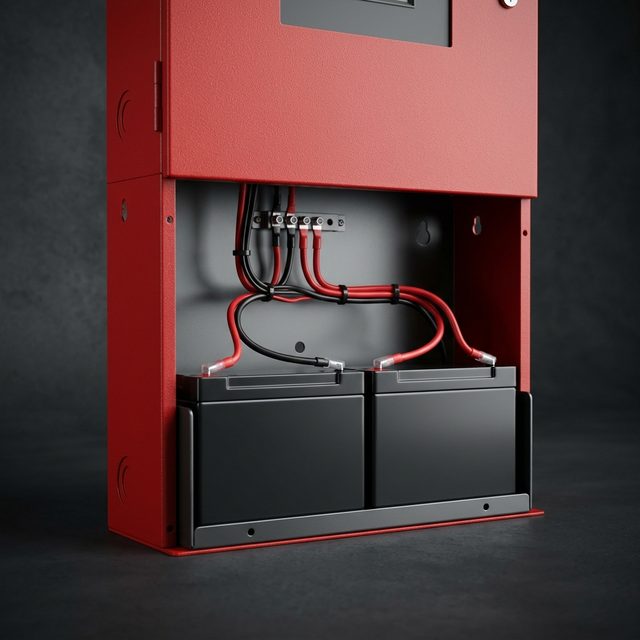
Every fire alarm system needs a primary power source (normally a dedicated branch circuit) and a secondary source, usually batteries or an engine generator with batteries. The secondary supply must run the system in normal standby for at least 24 hours after primary power fails, and then still operate every notification appliance in alarm for 5 minutes (15 minutes for emergency voice/alarm communication systems). Battery calculations prove this on paper, and they are part of the submittal and the acceptance test.

NFPA 72 reference

Chapter 10 — Fundamentals

10.6 Power Supplies; 10.6.7 Secondary Power Supply; 10.6.7.2.1 capacity (24 h standby + 5 min alarm, 15 min for EVACS)

On the job

A strip mall owner adds a dozen strobes to an existing panel. The installer bolts them on but never redoes the battery calc. On the annual test the batteries carry 24 hours of standby but drop below the panel's low-voltage cutoff after two minutes of alarm. The fix is a larger battery set — and a corrected calculation in the records.

Quick check

1. After losing primary power, the secondary supply must carry the system in standby for at least:

2. Following the standby period, a standard fire alarm system must sound alarm for:

3. An emergency voice/alarm communication system needs how long in alarm after standby?

Code section 7

Alarm beats supervisory, supervisory beats trouble

Alarm beats supervisory, supervisory beats trouble

NFPA 72 recognizes three main signal types and ranks them. An alarm signal (fire or other life-safety emergency) takes priority over a supervisory signal (something is off-normal, like a closed sprinkler valve), which takes priority over a trouble signal (a fault in the system itself, like an open circuit). Each must be distinctive so the person at the panel can tell them apart, and supervisory and trouble signals have to stay visible until the condition is restored.

NFPA 72 reference

Chapter 10 — Fundamentals

10.7 Signal Priority; 10.10 Distinctive Signals; 10.14 Supervisory Signals; 10.15 Trouble Signals

On the job

The panel shows a trouble for a ground fault when a sprinkler fitter closes the riser valve. The supervisory signal for the tamper switch must still come through and be distinguished from the existing trouble — and if a pull station is then activated, the alarm overrides both. A panel programmed so the trouble buzzer masks the supervisory indication is a code problem, not just a nuisance.

Quick check

1. Which signal has the highest priority?

2. A closed sprinkler control valve should produce a:

3. An open wire on a detector circuit produces a:

Code section 8

The Record of Completion is the system's birth certificate

The Record of Completion is the system's birth certificate

When a new system is installed or an existing one is modified, the installer must document it on a Record of Completion. It identifies the owner, the AHJ, the installing contractor, the equipment, the circuits, the power supplies and battery calculations, the monitoring arrangement, and the results of the acceptance test. The owner keeps it (and the as-built drawings) for the life of the system, and it is the first thing a future technician or inspector asks for.

NFPA 72 reference

Chapter 7 — Documentation

7.5 Completion Documents; 7.5.6 Record of Completion (updated whenever the system is modified)

On the job

You arrive to troubleshoot a panel you've never seen. The owner hands you the Record of Completion from the last modification: it lists the SLC loop devices added, the battery calc, and the monitoring account number. Twenty minutes later you've isolated the trouble to the newest module instead of ringing out every circuit in the building.

Quick check

1. A Record of Completion is required:

2. Who keeps the Record of Completion for the life of the system?

Code section 9

Taking a system out of service is an impairment — and it has rules

Taking a system out of service is an impairment — and it has rules

Any time part of a fire alarm system is taken out of service — for testing, repair, or construction — the code treats it as an impairment. The owner or their representative and the AHJ must be notified, the monitoring station must be told so they don't dispatch on test signals, a tag must be placed at the panel showing the system is impaired, and mitigation (such as a fire watch) may be required until service is restored. When work is done, everyone is notified again and the tag comes off.

NFPA 72 reference

Chapter 10 — Fundamentals

10.21 Impairments (10.21.1 through 10.21.4); see also 14.2.2 for notification before testing

On the job

A tech starts a zone-by-zone test without calling the central station. The first pull station sends an alarm, the fire department rolls, and the owner is billed for a false dispatch. Had the tech followed the impairment procedure — notify the owner, AHJ, and monitoring company, hang the tag, then test — the same work would have been routine.

Quick check

1. Before taking a system out of service for testing, you must notify:

2. A tag at the control unit during an impairment tells people that:

Knowledge Check

1. NFPA 70 refers to the:

2. Survivability / circuit integrity requirements for some ECS exist to:

3. NFPA 72 is best known as the:

4. The safest way to confirm an exact requirement is to:

5. When the adopted code edition differs from the newest published edition, you follow:

Troubleshooting tie-in

See how a missing EOL defeats supervision

Summary

Key takeaways

  • Explain what NFPA 72 covers and how it relates to NFPA 70 (NEC) and NFPA 101 (Life Safety Code).
  • Describe the practical difference between a 'standard' and a 'code', and why the adopted edition and local amendments determine what applies.
  • Identify the stakeholders who rely on NFPA 72 — designers, installers, inspectors, owners, and occupants.

Additional Resources

Code References

Adopted Code Editions — Verify Locally

Always confirm the NFPA 72 and NFPA 70 (NEC) editions adopted by your jurisdiction before using any concept from this trainer.

Best Practices

Working With Your AHJ

Engage the Authority Having Jurisdiction early. Local amendments and interpretations govern the final design.

Fire Alarm Blueprint Trainer provides educational guidance only. It does not replace professional engineering, licensed electrical work, approved fire alarm design, manufacturer installation instructions, applicable codes, or AHJ review.

© 2026 Fire Alarm Blueprint Trainer · Educational tool · Not affiliated with NFPA.