Learning Center

Fire Alarm Training Curriculum

A guided NFPA 72 learning path from fundamentals to advanced systems, in original plain language. These are learning aids only — always verify exact requirements in the officially adopted standards and with your AHJ.

NFPA 72 Learning Path

0/9 core modules passed

Ask a Fire-Code Question

Plain-language answers to NFPA 72/70 questions, grounded in cited web sources. Educational guidance only — not code or design authority.

Signal Types & Monitoring

NFPA 72 systems distinguish three signal types — alarm, supervisory, and trouble — and may report them off-site to a supervising station. Knowing what each signal means, and why a non-fire signal still matters, is core to operating and maintaining a system responsibly.

Why it matters

Occupants and technicians must react correctly to each signal. Treating a trouble or supervisory as 'not a fire, so ignore it' can quietly leave a building unprotected — a trouble is a warning that the system itself may not perform when needed.

Learning objectives
  • Differentiate alarm, supervisory, and trouble signals and the response each requires.
  • Explain why supervisory and trouble signals matter even when there is no fire.
  • Describe how a central/supervising station monitors a system and responds off-site.
Prerequisites

The three signal types

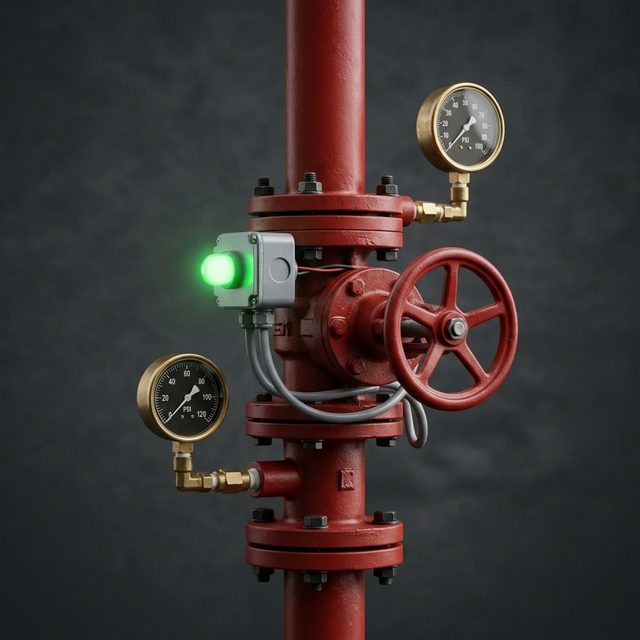
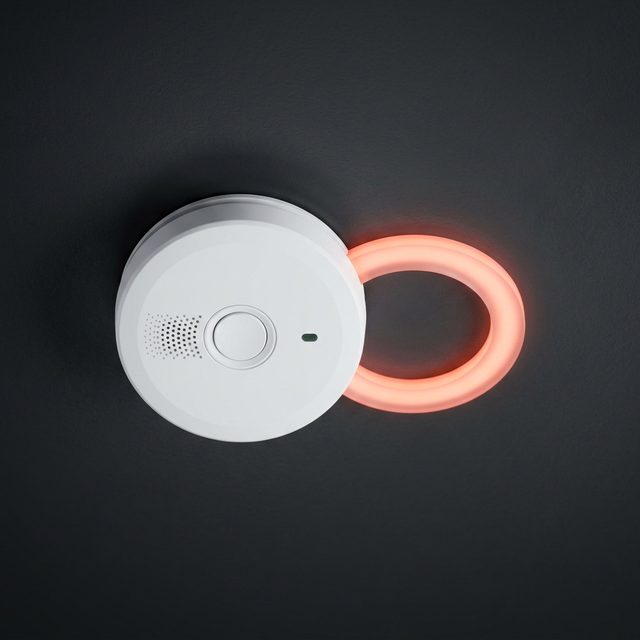
An ALARM signals a fire or life-threatening condition and calls for evacuation. A SUPERVISORY signal flags a condition that could impair protection — for example a closed sprinkler control valve. A TROUBLE signal reports a fault in the system itself, such as a wiring open, ground fault, or low battery.

The 'quiet emergency'

Trouble and supervisory signals do not evacuate the building, so they are easy to ignore — but an unaddressed trouble can mean the system will not warn people when a real fire happens. That is why the code treats prompt trouble response and repair as part of keeping the system reliable.

Off-site monitoring

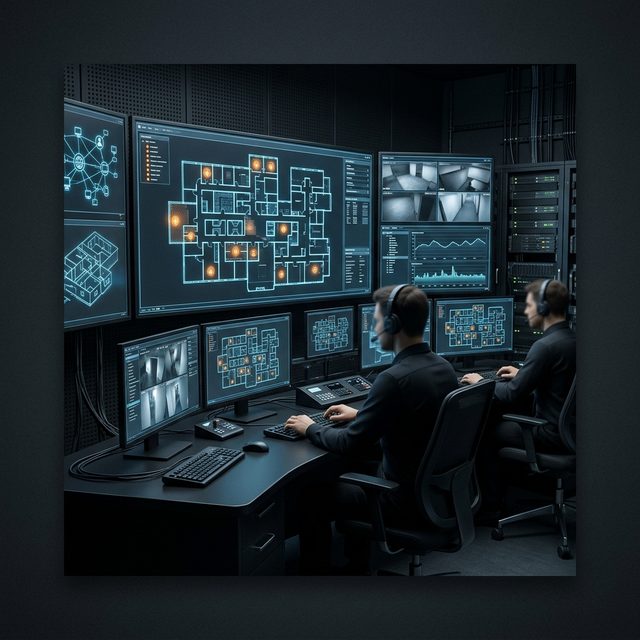
Many systems transmit signals to a supervising (central) station so that alarms, supervisories, and troubles get a response even when the building is unoccupied. The chain — device → panel → communicator → supervising station → dispatch/owner — is only as good as its weakest link, which is why the reporting path is itself supervised.

Interactive walkthrough

Step 1 of 3

The three signal types

An ALARM signals a fire or life-threatening condition and calls for evacuation. A SUPERVISORY signal flags a condition that could impair protection — for example a closed sprinkler control valve. A TROUBLE signal reports a fault in the system itself, such as a wiring open, ground fault, or low battery.

Key terms
Alarm signal
Indicates a fire/life-safety condition requiring evacuation.
Supervisory signal
Warns of a condition that could impair protection (e.g., a closed valve).
Trouble signal
Reports a fault in the system itself (open, ground fault, low battery).
Supervising station
The off-site facility that receives and acts on transmitted signals.
Common pitfalls / potential review items
  • • Treating a trouble or supervisory signal as unimportant because 'there's no fire'.
  • • Assuming a system reports off-site when the communication path is not actually supervised or tested.
  • • Confusing a supervisory (protection impaired) with a trouble (system fault).
Guided practice

A TROUBLE signal at the panel indicates:

Independent challenge

A closed sprinkler control valve most likely triggers which signal?

Code sections every tech should know

References use NFPA 72 2019/2022 numbering — section numbers can shift between editions, so confirm in the edition your AHJ has adopted.

Code section 1

Trouble signals must be heard, can be silenced, but can't be hidden

Trouble signals must be heard, can be silenced, but can't be hidden

A trouble condition has to produce an audible and visible indication at a location where someone can act on it — the panel or a remote annunciator where the building is attended. The audible part may be silenced, but the visible indication stays until the fault is cleared, and if a new, different trouble occurs while silenced, the sounder has to come back on (ring-back). Troubles also have to be transmitted to the supervising station when the system is monitored.

NFPA 72 reference

Chapter 10 — Fundamentals

10.15 Trouble Signals (10.15.1 indication; 10.15.6 silence with visible indication retained; 10.15.7 re-sound on subsequent trouble)

On the job

A school custodian silences a ground-fault trouble at 6 a.m. and goes about his day. At noon a NAC opens; because the panel is programmed correctly, the trouble buzzer re-sounds and the second fault is noticed. On an older panel with ring-back disabled, the open circuit would have sat silent behind the first silenced trouble.

Quick check

1. After the trouble sounder is silenced, the visible indication must:

2. If a different trouble occurs while the first is silenced, the panel must:
Code section 2

Silencing an alarm is allowed — forgetting it is not

Silencing an alarm is allowed — forgetting it is not

The code permits a means to deactivate (silence) alarm notification appliances, but only if the system is attended or the AHJ permits it, and a subsequent alarm from a different initiating device or zone must re-activate the appliances. The silence must also be indicated at the panel, and the system cannot be left silenced indefinitely — a silenced alarm that nobody resets is treated as an impaired system. Alarm silence is for investigation, not a workaround for a nuisance detector.

NFPA 72 reference

Chapter 10 — Fundamentals

10.12 Alarm Signal Deactivation (10.12.1 means to deactivate; 10.12.3 subsequent alarm re-activates; silence indication)

On the job

A restaurant manager silences the horns after a kitchen detector trips and leaves the panel in silence so the lunch rush can continue. A second detector activates in the dining room and, because the panel re-sounds on a new alarm, the room evacuates. Had the manager simply disabled the NACs, the second alarm would have been silent — the code difference between silencing and disabling.

Quick check

1. After alarm appliances are silenced, an alarm from a different zone or device must:

2. Alarm signal deactivation is intended for:

Code section 3

A supervisory signal needs both an 'off-normal' and a 'back to normal'

A supervisory signal needs both an 'off-normal' and a 'back to normal'

Supervisory signals report that a fire protection feature is off-normal — a closed sprinkler valve, low air pressure on a dry system, a tripped duct detector in some designs. The code requires the panel to indicate both the initiation of the supervisory condition and its restoration to normal, distinctly from alarm and trouble, and to keep the visible indication until it is restored. Restoration is a signal in its own right: the monitoring company and the owner need to know when the valve was reopened, not only when it was closed.

NFPA 72 reference

Chapter 10 — Fundamentals

10.14 Supervisory Signals (10.14.1 initiation and restoration indicated; 10.14.3 distinct from alarm/trouble)

On the job

A fitter closes the riser valve to replace a gauge, and the panel sends a supervisory to the central station. He reopens it an hour later but the tamper switch was adjusted wrong and never restores. The panel still shows supervisory, the central station calls the owner, and the misadjusted switch is found — exactly the behavior the restoration requirement is for.

Quick check

1. Which event must produce a supervisory signal?

2. The panel must indicate a supervisory condition's:

Code section 4

Central, proprietary, remote — three kinds of monitoring

Central, proprietary, remote — three kinds of monitoring

Chapter 26 defines three supervising station arrangements. Central station service is a listed, contracted service that includes monitoring, runner response, record keeping and testing under a documented agreement. A proprietary supervising station is owned and staffed by the protected property itself (a campus or large facility). A remote supervising station receives signals from one or more properties and retransmits them to the fire department. Which one a building has changes the paperwork, the response expectations, and what the AHJ expects to see on the Record of Completion.

NFPA 72 reference

Chapter 26 — Supervising Station Alarm Systems

26.3 Central Station Service; 26.4 Proprietary Supervising Station Alarm Systems; 26.5 Remote Supervising Station Alarm Systems

On the job

An owner tells the AHJ the building has "central station monitoring." The inspector asks for the central station certificate or placard; the owner only has an invoice from an alarm dealer. It turns out to be remote supervising station service — acceptable, but the Record of Completion and the placard at the panel have to say so.

Quick check

1. A supervising station owned and operated by the protected property itself is a:

2. Listed central station service includes:

Code section 5

Alarm verification buys 60 seconds — no more

Alarm verification buys 60 seconds — no more

Where permitted by the AHJ, a control unit can use an alarm verification feature for smoke detectors: on first activation it resets the detector and waits to see whether the alarm condition is still present before sounding the alarm. The entire verification period is limited to 60 seconds, the feature only applies to smoke detectors (never to manual boxes, heat detectors or waterflow), and a second detector or any other initiating device during the verification window must trigger an immediate alarm.

NFPA 72 reference

Chapter 23 — Protected Premises Fire Alarm Systems

23.8.5.4 Alarm Verification Feature (23.8.5.4.1 60-second maximum; 23.8.5.4.2 other devices alarm immediately)

On the job

A hotel programs alarm verification to stop shower-steam false alarms. During acceptance testing the inspector activates a pull station during a detector's verification window and expects an immediate alarm. The panel waits out the detector's delay instead — a programming error. Verification is reconfigured so only smoke detectors are delayed.

Quick check

1. The maximum total alarm verification period is:

2. Alarm verification may be applied to:

3. A pull station activated during a detector's verification window must:

Code section 6

Positive alarm sequence: 15 seconds to acknowledge, 180 to investigate

Positive alarm sequence: 15 seconds to acknowledge, 180 to investigate

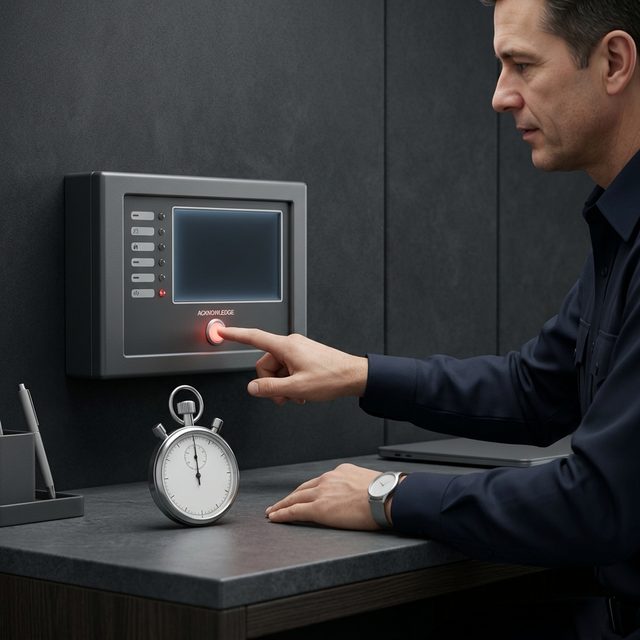
In attended buildings the AHJ may permit positive alarm sequence. When a detector activates, trained staff have 15 seconds to acknowledge the signal at the panel; if they don't, the full alarm sounds. If they do, they get up to 180 seconds to investigate and reset the system. If they fail to reset in time, a second device activates, or a manual box is pulled, the alarm sounds immediately. The sequence requires written AHJ approval and trained personnel on site whenever it is enabled.

NFPA 72 reference

Chapter 23 — Protected Premises Fire Alarm Systems

23.8.1.3 Positive Alarm Sequence (acknowledge within 15 s; investigation up to 180 s; immediate alarm on second device or manual box)

On the job

A high-rise lobby uses positive alarm sequence. A detector trips at 2 a.m. and the lone night guard, away from the desk, misses the 15-second acknowledge window — the building alarms, which is the safe outcome. The owner later asks to extend the acknowledge time to five minutes; the code does not allow it, and the AHJ declines.

Quick check

1. Under positive alarm sequence, staff must acknowledge the first signal within:

2. The maximum investigation period after acknowledgement is:

3. During the investigation period, a pull station activation:

Related modules

We never embed copyrighted code text — add your own authorized references.

Knowledge Check

1. Documentation of inspection/testing is important because it:

2. A 'trouble' (supervisory) signal typically indicates:

3. A key reason to notify the monitoring station before testing is to:

4. Off-site monitoring matters most because it:

5. A wiring open or low battery typically produces a:

Troubleshooting tie-in

See a trouble signal appear from an open IDC

Summary

Key takeaways

  • Differentiate alarm, supervisory, and trouble signals and the response each requires.
  • Explain why supervisory and trouble signals matter even when there is no fire.
  • Describe how a central/supervising station monitors a system and responds off-site.

Additional Resources

Code References

Adopted Code Editions — Verify Locally

Always confirm the NFPA 72 and NFPA 70 (NEC) editions adopted by your jurisdiction before using any concept from this trainer.

Best Practices

Working With Your AHJ

Engage the Authority Having Jurisdiction early. Local amendments and interpretations govern the final design.

Fire Alarm Blueprint Trainer provides educational guidance only. It does not replace professional engineering, licensed electrical work, approved fire alarm design, manufacturer installation instructions, applicable codes, or AHJ review.

© 2026 Fire Alarm Blueprint Trainer · Educational tool · Not affiliated with NFPA.