
NFPA 72 code sections · Circuit Faults: Finding Grounds, Shorts and Opens
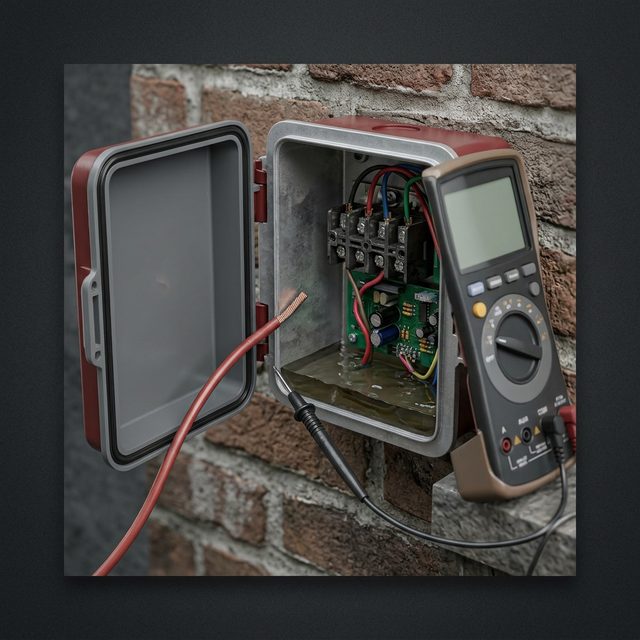
Ground fault: a conductor touching earth
A ground fault is any field conductor — positive or negative — making contact with something grounded: a box, conduit, a strut, a wet floor slab, a bare EMT edge. One ground fault does not stop the circuit from working, which is exactly why NFPA 72 requires the panel to detect it: a second fault somewhere else turns two 'harmless' grounds into a short or an open. On the panel you see a TROUBLE with a 'Ground Fault' or 'GND' indicator (usually panel-wide, not per circuit), the trouble buzzer, and a trouble signal to the supervising station. Some panels show the resistance to ground or which side (+ or −) is grounded.
Common causes on the job
- Nicked insulation where cable enters a box or pulls across a sharp knockout without a bushing
- Water in an exterior horn/strobe, a weatherproof box, or an underground conduit after rain
- A stray strand touching the backbox or a terminal screw pinching the jacket
- Device base or module mounted so a terminal touches the metal box
- Another trade: a drywall screw, ceiling grid wire or sprinkler hanger through the cable
- A grounded shield drain wire on an SLC landed at both ends, or a battery lead rubbing the cabinet
How to find it, step by step
- Read the panel: note whether the ground indicator says + or −, the time it started, and what else changed in the building that day (rain, remodel, new trade).
- Confirm the fault is real: clear the event history, reset, and see if it returns. Intermittent grounds that come and go with weather are water; constant ones are mechanical.
- Isolate at the panel: lift one field circuit at a time (NAC, IDC, SLC, aux power, communicator) and watch the ground indicator. When it clears, you have the circuit.
- Split the circuit: go to a device near the midpoint, lift the outgoing conductors, and see whether the ground stays (upstream) or clears (downstream). Repeat, halving the run each time.
- Meter it: with the circuit de-energized at the panel, measure resistance from each conductor to a known ground. A good circuit reads open (OL); the faulted conductor reads low or a few kΩ if wet.
- Fix the cause, not the symptom: re-terminate, add the bushing, replace the wet appliance, reroute from the screw. Dry out and reseal wet boxes.
- Restore and prove it: reconnect, verify the ground indicator stays clear, test the devices you disturbed, and record the repair and reacceptance on the ITM form.
NFPA 72 reference
Chapter 12 — Circuits and Pathways / Chapter 10 — Fundamentals
12.6.1 single ground fault on installation conductors shall result in a trouble signal; 12.6.2 trouble indicated within 200 s; 10.15 trouble signal indication and re-sound
References use NFPA 72 2019/2022 numbering — section numbers can shift between editions, so confirm in the edition your AHJ has adopted.
On the job, step by step
- Monday morning the hospital's panel shows TROUBLE — GROUND FAULT (−). The night tech reset it twice; it came back within minutes each time. It rained hard Sunday.
- Maria pulls the event history: the ground first appeared at 2:14 a.m., with no other events. She checks the building log — a roofing crew finished Friday.
- At the panel she lifts NAC 1: ground stays. NAC 2: ground stays. NAC 3 (the exterior strobes on the loading dock): the GND light goes out. Circuit found in ten minutes.
- She walks NAC 3 and splits it at the third strobe. Lifting the outgoing pair clears the fault, so the problem is downstream — two more strobes and a weatherproof box under the new roof edge.
- The last box has water pooled behind the gasket; the roofers had moved the downspout. Her meter reads 4 kΩ from the negative conductor to the box.
- She replaces the strobe and gasket, drills a weep hole as the manufacturer allows, and asks facilities to fix the downspout.
- Back at the panel, NAC 3 reconnects with no ground. She trips the circuit to confirm all strobes flash, fills out the ITM record, and notifies the supervising station the system is back to normal.
Quick check
1. A single ground fault on a NAC usually:
2. Fastest way to find which circuit carries a ground fault:
3. A ground fault that appears after rain and clears on dry days most likely points to:
Listen to this section
AI-narrated, about a minute.
Ask about this section
Get a plain-language explanation of what this rule requires and what to check on the job.
3 free explanations left on this device.